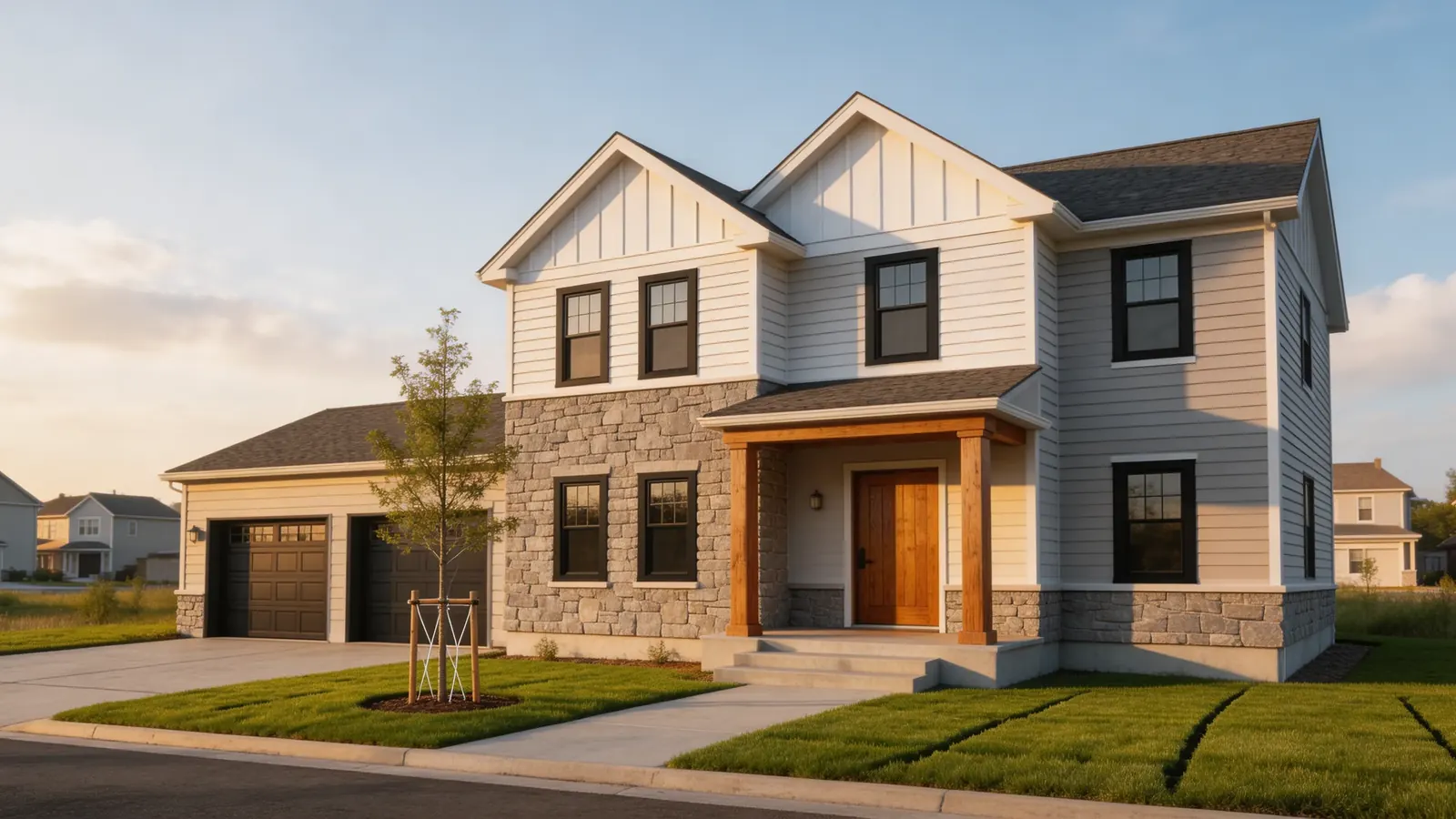
How slab foundations work
A slab foundation is a concrete pad poured on the ground, usually with thicker beams or footings around the edges and sometimes under interior walls. There is no crawl space and no basement. Slabs are fast and cheap to build, which is why so many subdivisions around Murfreesboro, Smyrna and La Vergne use them. The downside is that the slab rides directly on the soil. When clay under it shrinks, swells or settles, the slab moves with it.
Settling, heaving and cracking
Settling is when part of the slab drops, usually an edge or a corner. You see cracks running in from that side of the house, doors that drag, and a gap where the floor meets the baseboard. Heaving is the opposite. The middle of the slab or one area rises, often because water has collected under it and swollen the clay. Heave can look similar to settling from inside the house, which is why a contractor should measure floor elevations instead of guessing.
Then there are cracks that are not structural at all. Concrete shrinks as it cures, and most slabs develop fine cracks in the first year or two. Those are normal. The ones to watch are cracks that widen, cracks where one side sits higher than the other, and cracks that show through tile or hardwood.
Why slabs move here
Around Murfreesboro, slabs sit on clay soils formed from limestone. Many of those soils are moderate to high on the USDA shrink-swell scale, and rock often sits only a few feet down. A slab can end up partly over rock and partly over clay, or over fill that was placed to level a sloped lot. Water makes all of it worse. A slow leak in a drain line under the slab, a downspout dumping at one corner, or a flower bed that gets watered every evening can all change how the soil under the slab behaves.
Repair options
Piers under the perimeter
For a settling edge or corner, the standard repair is steel push piers or helical piers installed under the perimeter beam. The crew digs next to the footing, installs brackets and piers, and then lifts the slab as far as it will safely go.
Interior piers
When an interior beam or wall line has dropped, piers can be installed through the slab from inside the house. It is more disruptive, since flooring has to come up in those spots, but it is sometimes the only way to reach the problem.
Slab lifting with foam or grout
For a sunken section of slab that is not carrying a wall, like a garage floor, patio, or walkway, contractors can drill small holes and pump in polyurethane foam or a cement grout to lift it. Angi lists mudjacking at about $500 to $1,300 (Angi, 2026). Lifting does not fix the soil under it, so it suits sections where the soil has stopped moving.
Leak testing and water control
If the slab is heaving, find the water first. A plumber can pressure test the supply lines and run a camera or a static test on the drain lines under the slab. Outside, regrading, downspout extensions and sometimes a French drain keep water away. Any good slab repair estimate should address water, even if only to say it was checked.
What slab repair costs
Angi's 2026 data puts concrete slab repairs anywhere from $350 to $20,000, depending on the method and the damage. Piers run $1,000 to $3,000 each, and a typical perimeter job uses several. Leak detection, plumbing repair and drainage are usually priced separately. See our cost guide for the full breakdown.
Questions to ask
- Is this settling or heave, and how did you tell?
- Did you take floor elevation readings? Can I have a copy?
- Should the plumbing under the slab be tested before any repair?
- Are you lifting, or only stabilizing?
- What happens to the tile and drywall when you lift?
- Is drainage included in this price?
Rutherford County is one of nine Tennessee counties that adopted the state home improvement law. Here, a contractor doing a residential job worth $3,000 to $24,999 needs a home improvement license and a $10,000 surety bond, according to the Tennessee Board for Licensing Contractors. Jobs of $25,000 or more need a full state contractor license anywhere in Tennessee. You can look up any license at verify.tn.gov.